Live now
People sharing their headband at this moment, each under a fresh pseudonym and only at the tier they chose: a name, activity and mood if they typed them; the headband model and battery; contact per electrode; band powers per channel; head motion; the gated activation estimate; heart rate and HRV; the optical channels; the raw trace. Cameras appear here too, when the computer they hang off opens its gateway: the picture comes from that computer to this browser, not through the relay. A headset can appear here as well, as a cloud of splats from its depth sensing, drawn in 3-D. connecting…
The relay keeps nothing of the signal unless the person left “keep this share” on in the app; then what they streamed, at the tier they chose, is kept and listed under The record below with its summary (when, how long, activity, moods stated, contact, bands, pulse), and they can remove it from their phone. A name, an activity and a mood on a card are what that person typed; the mood is their own rating on the affect grid, never read from the signal. This page listens to the Collective's relay (cyborg-collective-relay.onrender.com); to point it at another, add ?relay=wss://host/live to the address once; it is remembered in this browser only.
Scans in 3-D
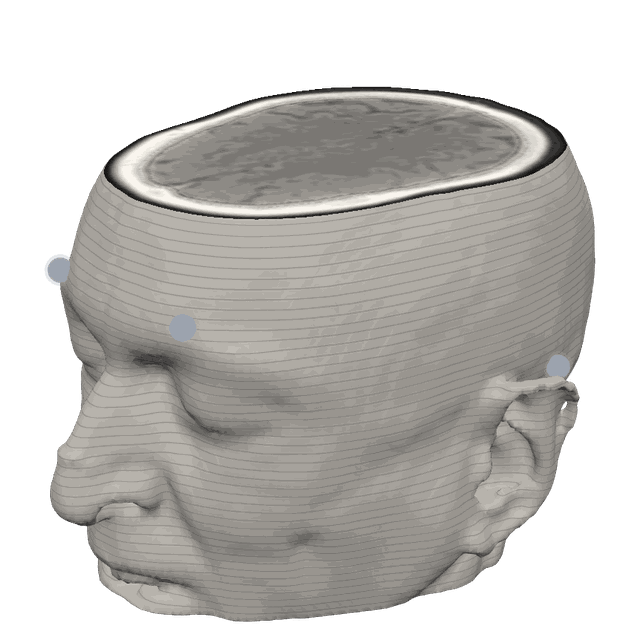
What a person wearing a headset looks at, rebuilt in 3-D: drawn as Gaussians while they look, trained into a Gaussian splat minutes later, and for an object made into a solid that can be printed and held. Each result says whether a headset saw it or whether it is a test of the method against a shape that is known.
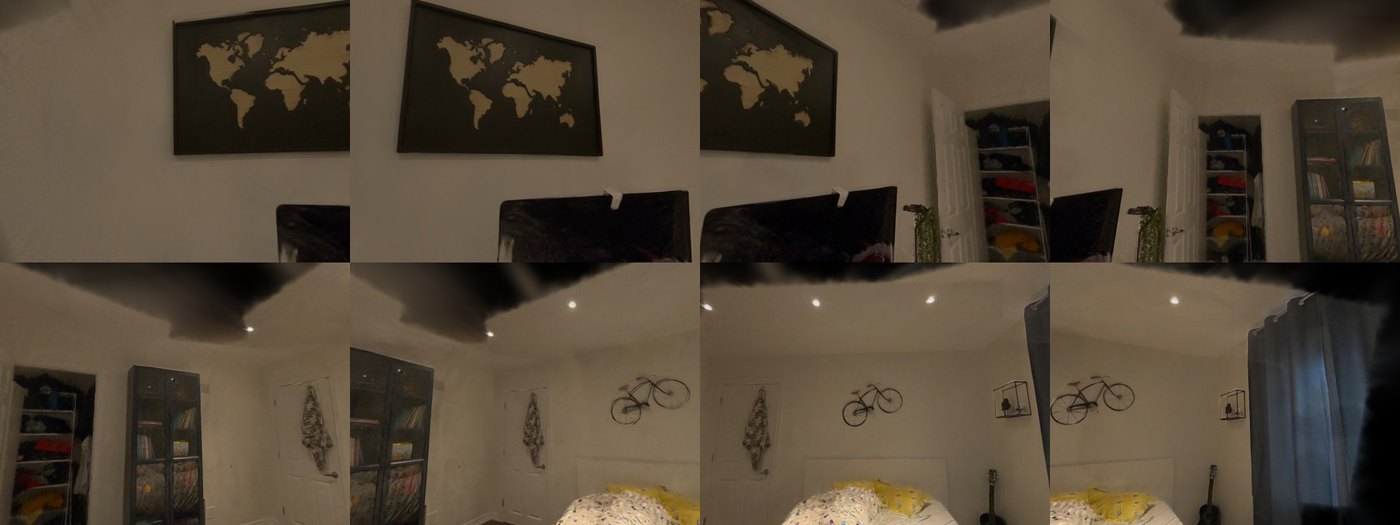 The scansEach one opens in 3-D, to turn round or to look round from where it was photographed, with its numbers and its files.
Live Gaussian splattingWhat a headset is scanning now, drawn as Gaussians while it scans. When nobody is scanning, the most recent finished scan.
How a scan is madeThe chain from headset to print file, what has been checked and what has not, and every tool as a plain file.
Scans from phones
A head, or a place, photographed with a phone in MuseLog's Scan in 3-D and sent here by the person who made it, as a ROS 2 bag: the pictures, the phone's motion, and brain waves if a headband was on. A computer with a graphics card trains a Gaussian splat from the pictures; until it has, the scan is listed as waiting. The pictures themselves are not published, and the person can remove their scan from their phone.
Trust
The rule this page runs on, shown twice. First a benchmark from the author's work on AI that proposes and exact checks that dispose: the interface may say verified only when a check fired. Then that rule applied to every kind of number on this page, with what was checked and what was not.
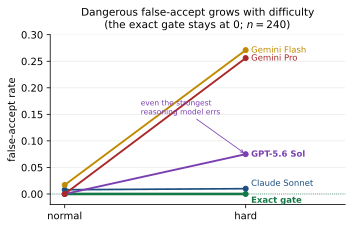
False acceptance of false exact claims, normal against hard, for four frontier models and the exact gate (the project's difficulty curve, drawn from the results in Table 2 of the preprint; n = 240, Gemini Pro's hard tier n = 80).
AI with a receipt A model proposes. An exact check disposes. The answer carries a tier, and the tier verified can only come from a check that fired: in the preprint that is a theorem about the software, not a policy. On 240 claims in four domains (unit fractions, modular arithmetic, hadron quantum numbers, ground-state energies) the gate admitted no false claim at full coverage. Every model did.| Judge of hard exact claims | False acceptance [95% interval] |
|---|---|
| Exact gate | 0.000, at full coverage |
| Claude Sonnet | 0.010 [0.002, 0.055] |
| GPT-5.6 Sol | 0.075 [0.040, 0.136] |
| Gemini 2.5 Pro | 0.256 [0.146, 0.411] |
| Gemini 2.5 Flash | 0.271 [0.196, 0.362] |
The preprint (PDF, 2026)The benchmark and the gatesNew Axiom, the chat that wears the tier
| The claim | What is checked | Tier |
|---|---|---|
| “97 is prime” | Exact arithmetic, in New Axiom. | Verified |
| “This page contains the word you searched for” | The page was fetched and read before it was listed (the verified search in the CanOS browser). | Verified |
| Electrode contact on a live headband | The headband's own quality signal per electrode; with fewer than 3 of 4 in contact the app sends no claim. | Measured |
| A two-second epoch in the record | Counted clean only when its peak-to-peak swing stays under 200 µV. | Measured |
| The activation estimate on a card or in the game | A z-score against the person's own baseline, with an EMG guard and contact gating; never called emotion. | Estimated |
| A mood on a card or in a check-in | Typed by the person; never inferred from the signal. | Self-reported |
| “Adapt the EEG model to this person” | An audit of eight adaptation methods found their failures land on corrupted windows, so the model holds there. | Refused |
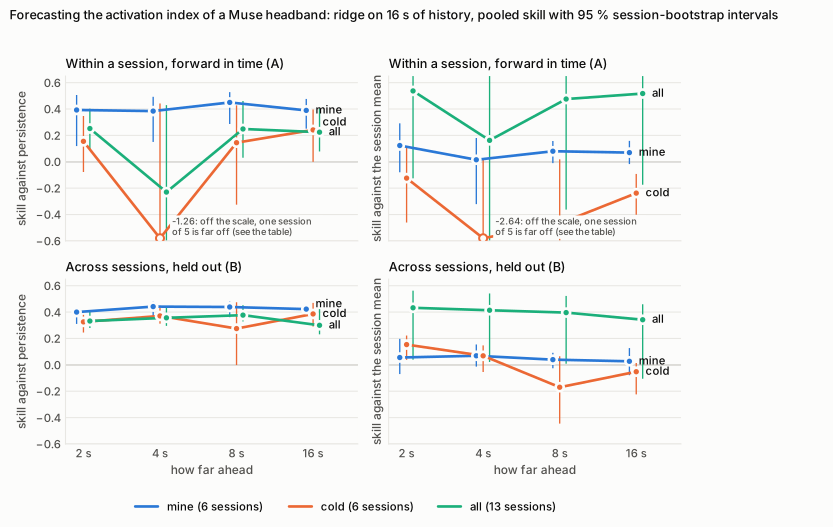
Ridge on the lags, trained on other sessions: pooled skill with its 95 % interval.
| Pool | vs. persistence, 2 s | 16 s | vs. the session mean, 2 s | 16 s |
|---|---|---|---|---|
| the owner's head (6 sessions) | +0.38 [+0.27, +0.44] | +0.38 [+0.26, +0.42] | +0.03 [-0.07, +0.15] | -0.05 [-0.20, +0.03] |
| cold periods (6) | +0.33 [+0.25, +0.38] | +0.40 [+0.29, +0.46] | +0.16 [+0.06, +0.22] | -0.03 [-0.20, +0.01] |
| all (13) | +0.36 [+0.33, +0.41] | +0.36 [+0.32, +0.42] | +0.46 [+0.04, +0.59] | +0.40 [-0.07, +0.52] |
The whole reading, the pre-registration, every number, the model's ledgersThe code (zip)
The record
Every recording the phone's recorder has made, and every live share a person chose to keep, summarised: when, how long, which headband, how well the electrodes held, what the bands and the pulse did. Numbers and previews only; the raw samples stay with their owner, or, for a kept share, with the relay until the person removes it. One exception, listed in full in music/eeg/: the minute of one electrode that the band's waves are drawn from. The whole list is also on a plain page that needs no script.
| when | project | min | headbands | clean EEG | pulse |
|---|
Check-ins
Daily check-ins people chose to publish: three minutes of eyes-open rest, then how they rated themselves, how they slept, what they drank. Their rating sits beside the resting estimate so the two can be compared, never merged. Each person can remove theirs from their phone.
| when | who | doing | self-rated | sleep | caffeine | resting estimate | usable | pulse |
|---|
loading…
Shared live sessions
Every live share the person allowed to be logged: when, how long, at which tier, what they were doing, every mood they stated while the window was open, and the summary numbers the page showed. Never the signal. Each person can remove theirs from their phone.
| when | who | doing | length | tier | moods stated | estimate (usable) | pulse | ended |
|---|
Camera recordings
What the cameras recorded, as ROS 2 bags (MCAP): one bag per hour per camera, JPEG frames on a sensor_msgs/msg/CompressedImage topic stamped in wall-clock time, with rosbag2's metadata.yaml beside each. The files stay on the computer the cameras hang off; they are listed and download from there while its gateway is on.
| started | camera | topic | length | frames | size | download |
|---|
loading…